Resources
Case Study: Commercial Strawberry Production
- Testing Candeo Lava Products for Growth and Production.
- Applied with Commercial Equipment in Winter-Spring Production Strawberries 2016
- Location: Oxnard, CA
Objectives:
To measure early growth responses and final production of strawberry when grown in a soil blended with Candeo Lava products based on possible nutrient and water retention responses to the products
For detailed data charts, results and discussion:
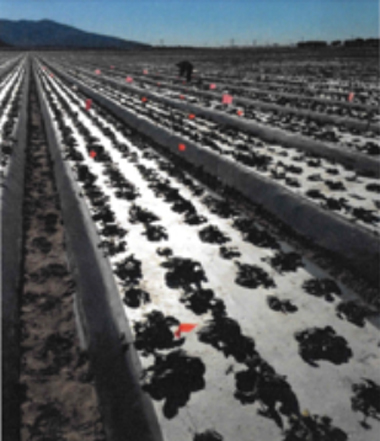
Strawberry Study Summary
Crop Description:
Fragaria x Ananassa Garden Strawberry
Geographic Area/Environmental Considerations:
Field environment of strawberry grown for commercial production.
Data to Collect:
- SPAD, two leaf petiole samples at mid and late season timing.
- Rate plant development twice for vigor and crown development. Possibly look at root and shoot development.
- Harvest berries for 3-4 months during the prime production and pricing period (Jan. to April) 24-30 harvest dates.
Methods and Materials:
The Fronteras (UC variety) strawberries utilized for this trial was grown in a commercial block of strawberries. This trial was set up as a completely randomized block trial of multiple Candeo Lava programs along with multiple rates of pre-plant fertilizer and reduced application of in season water compared to a grower standard with completely randomized data collection of four replicates maintained during the growing season.
All treatments received at planting controlled release fertilizer and in season applications of N-P-K . All materials were applied as pre-plant shanked in applications in the vicinity of the grower controlled release fertilizer. All rates and timing can be found in the tables associated with this report. No problems with phytotoxicity were noted through the use of this material.
Treatment 1Grower Standard |
Treatment 2– |
Treatment 3– |
Treatment 4– |
Treatment 5– |
Treatment 675%, 50% grower standard fertilizer plus 1000 lbs per acre raw grind Candeo Lava. |
Treatment 775% water, half the grower normal fertilizer, plus the two rates of Candeo Lava. |
Treatment 8Grower Standard pre-plant fertilizer at 50% plus 1000 lbs per acre raw grind Candeo Lava, no water reduction. |
Treatment 950% Grower Standard fertilizer plus two rates of Candeo Lava. |
18% More Yield
Treatment 8 produced the most flats of strawberries during the trial period with 3288 flats per acre, compared to the Grower Standard at 2923 flats per acre.
X% More Marketable Returns
A different perspective of how the rated production affected final grower returns is to look at the daily marketable returns based on USDA Shipping Point Market Prices for each pick day. This data is represented as the net back to grower after costs of approximately $6.00 per tray were removed that would represent picking labor, carton and tray costs, transportation to the cooler, and cooling costs associated with picking the strawberries.
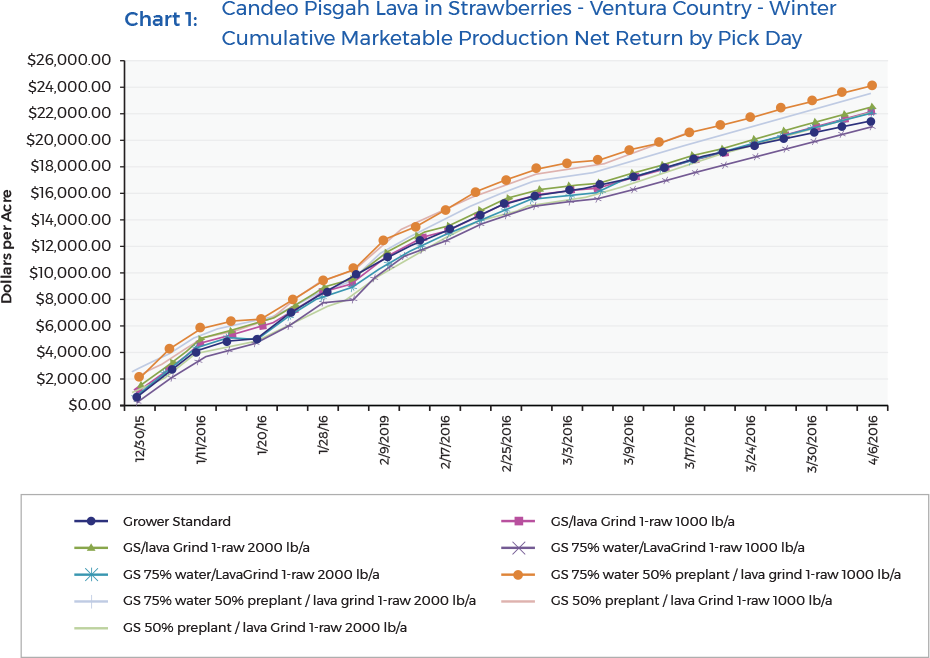
Based on this data, numerically cumulative seasonal increase to the grower’s return was seen by the use of the Treatment 6 over the other treatments, with a numerical return noted with a cumulative total for this treatment of $24,158 per acre for this program period, and $21,593 per acre for the grower standard.
The net differential in returns to the farm for each pick day for the treatment programs over the grower standard, which in this case was $2564 per acre more for the season for the Treatment 6 program (not taking into account the water and fertilizer savings and the extra cost of the lava).
25% Less Water Required
Soil water was tracked through the placement of Irrometer tensiometers with the ceramic tips placed at 12 inches of depth in the center of the beds.
Irrometer’s use a scale of numerical reading of 0-100 as soil moisture draws down and in the case of this sandy soil irrigation would normally be required when the tensiometers read about 20-25. At no time during this trial were average readings ever close to that number.
It should be noted that the moisture readings were no different between the untreated grower soil with full water and the two treatments of Candeo raw lava (Treatments 1-3), but in the case of the two treatments with Candeo raw lava and water reduced 25% during the season significant more drying was observed.
No significant total production differential was noted between Treatments 1-5, but the Grower Standard, Treatment 1, had the lowest total yields, while the two rates of Candeo Lava with reduced irrigation exceeded both the grower standard and the grower standard plus Candeo grown on normal water regime.
50% Less Fertilizer Required
It should also be noted that Treatments 6 and 7 had even higher yields. Treatments 6 and 7 were very close in yields to Treatments 8 and 9 (50% grower standard fertilizer plus two rates of Candeo lava).
All data rated as significant was done so utilizing the New Duncan’s Multiple Test Range at a 90% confidence level.
Conclusions:
Increasing numerical yields occurred throughout the use of the Candeo Lava raw product and these differences did correlate slightly to the amount utilized in the beds. But, no significant differences were noted in production in this trial.
The best production seems to correlate to the use of the lava product and the growers reduction in fertilizer.
In turn, better production was also noted with less water when the use of the lava was compared to full water and reduced seasonal water.
All of this would suggest that the Candeo lava is helping to hold water in the root zone, when less water is utilized. But it would also seem to indicate that more plant necessary nutrients are also being retained in the root zone due to the use of the lava. All of which is beneficial in times of drought and desire to reduce nutrient leaching out of the root zone.